

Diaphragm wall construction beneath existing infrastructure: BAUER Cube System deployed on site in Antwerp
- Completion of the Antwerp motorway ring road via the Oosterweel link to improve traffic flow and safety
- Complex diaphragm wall work on Groenendaallaan under confined conditions and high groundwater levels
- BAUER Cube System in use for the construction of diaphragm walls up to 30 m deep in sensitive environments
Antwerp, Belgium – With the Oosterweel Link, Antwerp is currently implementing one of the largest infrastructure projects in Belgium. After more than 60 years, the city’s ring road is being fully completed. The project aims to improve traffic flow, relieve the heavily congested Kennedy Tunnel, and enhance overall road safety.
The Oosterweel Link is part of the major project “De Grote Verbinding”, which seeks to reorganize mobility across the greater Antwerp area. A central element is a new, predominately underground ring-road segment. At surface level, green spaces and areas for non-motorized traffic are being created.
Groenendaallaan Section: Cutter Operations in Confined Conditions
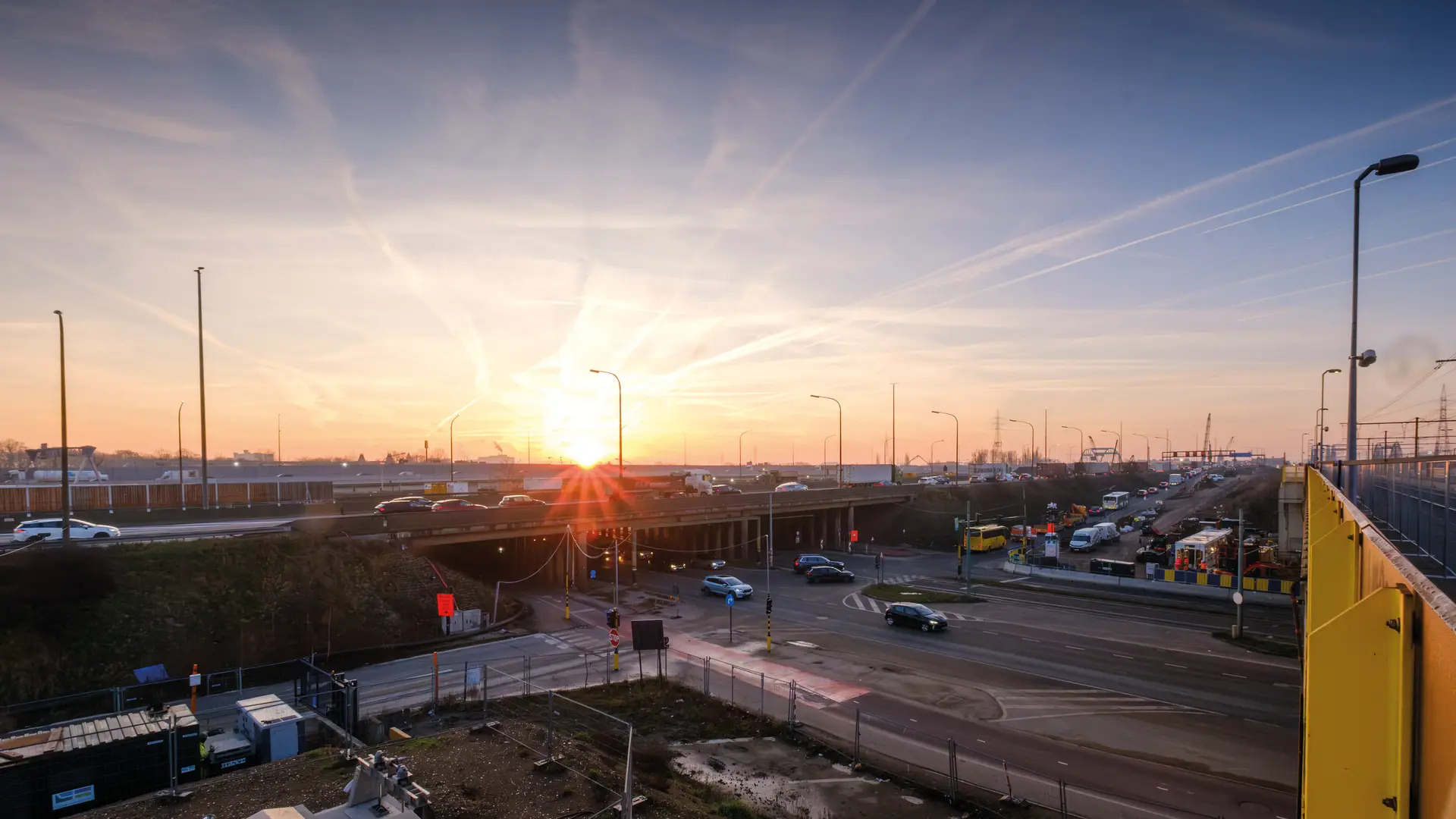
Part of the construction work is focused on the Groenendaallaan area. Existing road sections as well as on- and off-ramps are being lowered and covered. One of the key challenges is executing diaphragm wall construction beneath an existing bridge, where available working space is extremely limited: clearance height is approximately 4.8 m, with a width of about 5 m. In addition, bicycle paths run along both sides that need to be worked on. The groundwater level in this area lies just below ground level, requiring comprehensive dewatering and sealing measures as part of the construction work.
Premiere for the BAUER Cube System
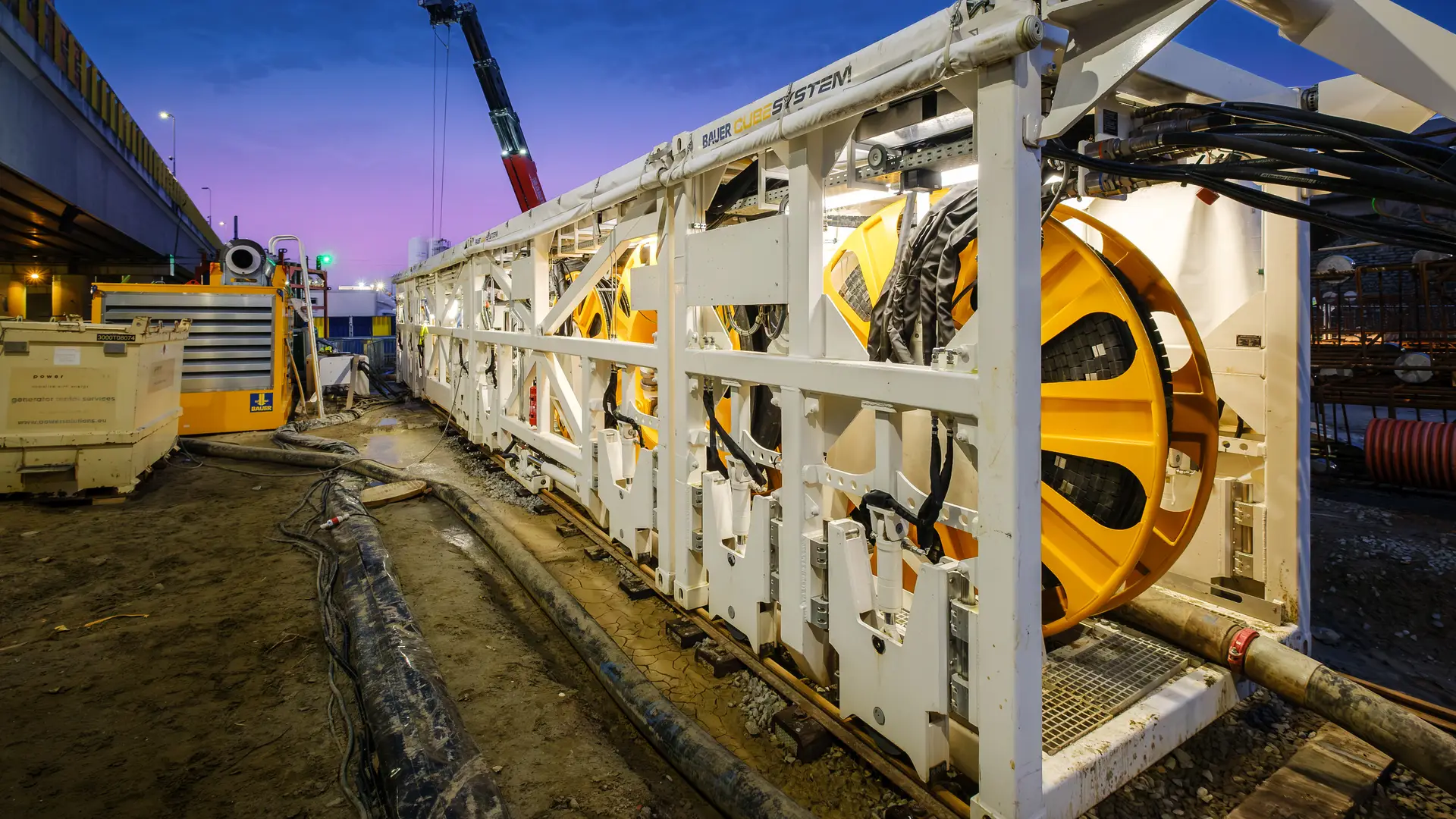
The diaphragm walls at Groenendaallaan – up to 30 m deep and 1 m wide – are being constructed using the BAUER Cube System. On site, the Cube System is translated into concrete execution by Future Foundations, a subsidiary of Denys specialising in foundation techniques and complex underground construction, together with partner I.CO.P.
Modular system
The Cube System was jointly developed by BAUER Maschinen GmbH and Denys, specifically for diaphragm wall construction from within existing tunnels. This concept also enables execution of projects in confined and sensitive surface environments. It is a modular, container-based system for diaphragm wall construction. All components are designed to fit into standard high-cube containers, eliminating the need for complex heavy transport and significantly simplifying site logistics. The system can be operated with either an HD-1400 diesel or an HE-1400 electric power pack – a particular advantage for inner-city projects with strict emission requirements.
Minimal intervention, maximum value
Thanks to its compact design, the system can be deployed in locations where conventional diaphragm wall cutters cannot operate due to space constraints, existing structures, or overhead construction. In addition to surface-level applications, the Cube System can be used inside existing tunnels or beneath transport infrastructure – such as during subway station construction – without requiring extensive surface intervention.
“The Groenendaallaan project clearly demonstrates where the added value of our system lies,” says Christian Riedl, Senior Product Manager Diaphragm Wall Technology at BAUER Maschinen GmbH. “When limited headroom and existing structures come together, conventional cutter systems reach their limits. In the past, alternative construction methods often had to be used – even when a diaphragm wall would have been the ideal solution. The BAUER Cube System was developed precisely for these situations.”
The “De Grote Verbinding” project at a glance
The Oosterweel Link comprises three major structures: the new Scheldt Tunnel, the Oosterweel Interchange, and the Canal Tunnels. The approximately 1.8-km-long Scheldt Tunnel features three traffic lanes in each direction, along with a separate bicycle tube roughly 6 m wide. The Canal Tunnels run beneath the Albert Canal and consist of four stacked tunnel tubes arranged on two levels. The Oosterweel Interchange connects the tunnels, the ring road, and the port, and is largely constructed underground. Construction will span several years. The tunnel connection is expected to open for bicycle traffic around 2028, with full commissioning for motorized traffic planned for approximately 2030.
Press Images
Download
Your Contact


Specialized press Equipment, regional press, HR press